
COROUTINES
To understand coroutines first we should know about subroutines.
In computer programming, a subroutine is a sequence of program instructions that perform a specific task. For example a program for addition, subtraction. Subroutines is also known as function.
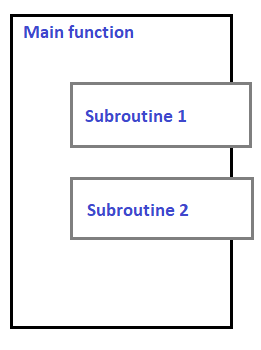
Coroutines are generalizations of the subroutines.
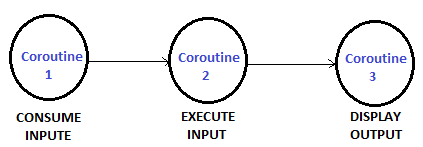
A subroutine has the same starting point and the same endpoint all the time, while a coroutine has multiple entry points for suspending and resuming execution. Coroutines are cooperative, that means if a coroutine consume input data, another coroutine can consume it, and another coroutine can be used to display the output.
Coroutines are nothing but cooperative functions.
Viva Vice on Coroutines
Q1. Explain what is meant by a recursive subroutine.
Answer =A recursive subroutine is simply one that calls itself either directly or through a chain of calls involving other subroutines.
Q2. Coroutine is just another name for a subroutine. True/False.
Answer = True
Q3. A two pass assembler uses its machine opcode table in the first pass of assembly. True/False.
Answer = True
Q4. Explain what is meant by a recursive subroutine.
Answer =A recursive subroutine is simply one that calls itself either directly or through a chain of calls involving other subroutines.
Q5. How many coroutines can run at a given time?
Answer - Only one coroutine can run at a given time.
Q6. What is coroutine?
Answer = Coroutine is a function that allows pausing its own execution and resuming from the exact same point after a condition is met.
Q7. How to Start Coroutine?
Answer = Coroutine can be start by using the StartCoroutine() function.
Q8. How to Stop Coroutine?
Answer = Coroutine can be stop by using the StopCoroutine() function.
Q9. Which type of method is used to start and stop coroutine?
Answer = It use IEnumerator based method to Start and Stop Coroutine.
Principles of Programming Languages:
EasyExamNotes.com covered following topics in these notes.
- Language Evaluation Criteria
- Influences on Language Design
- Language Categories
- Programming Paradigms
- Compilation
- Virtual Machines
- Programming Environments
- Issues in Language Translation
- Parse Tree
- Pointer and Reference type
- Concept of Binding
- Type Checking
- Strong typing
- Sequence control with Expression
- Exception Handling
- Subprograms
- Fundamentals of sub-programs
- Scope and lifetime of variable
- Static and dynamic scope
- Design issues of subprogram and operations
- Local referencing environments
- Parameter passing methods
- Overloaded sub-programs
- Generic sub-programs
- Design issues for functions
- Co routines
- Abstract Data types
- Abstraction and encapsulation
- Static and Stack-Based Storage management
- Garbage Collection
- OOP in C++
- OOP in Java
- OOP in C#
- OOP in PHP
- Concurrency
- Semaphores
- Monitors
- Message passing
- Java threads
- C# threads
- Exception handling
- Exceptions
- Exception Propagation
- Exception handler in C++
- Exception handler in Java
- Introduction and overview of Logic programming
- Basic elements of Prolog
- Application of Logic programming
- Functional programming languages
- Introduction to 4GL
Practicals:
- Memory Implementation of 2D Array.
- Memory Implementation of 3D Array.
- Implementation of pointers in C++.
- Write a program in Java to implement exception handling.
- Write a program in C++ to implement call by value parameter passing Method.
- Write a program in C++ to implement call by reference parameter passing Method.
- Write a program in Java to implement concurrent execution of a job using threads.
- Implement Inheritance in C#.
- Implement Encapsulation in C#.
- Implement static/compiletime Polymorphism in C#.
- Implement dynamic/runtime Polymorphism in C#.
Previous years solved papers:
A list of Video lectures
References:
- Sebesta,”Concept of programming Language”, Pearson Edu
- Louden, “Programming Languages: Principles & Practices” , Cengage Learning
- Tucker, “Programming Languages: Principles and paradigms “, Tata McGraw –Hill.
- E Horowitz, "Programming Languages", 2nd Edition, Addison Wesley
- Memory Implementation of 2D Array.
- Memory Implementation of 3D Array.
- Implementation of pointers in C++.
- Write a program in Java to implement exception handling.
- Write a program in C++ to implement call by value parameter passing Method.
- Write a program in C++ to implement call by reference parameter passing Method.
- Write a program in Java to implement concurrent execution of a job using threads.
- Implement Inheritance in C#.
- Implement Encapsulation in C#.
- Implement static/compiletime Polymorphism in C#.
- Implement dynamic/runtime Polymorphism in C#.
Previous years solved papers:
A list of Video lectures
References:
References:
- Sebesta,”Concept of programming Language”, Pearson Edu
- Louden, “Programming Languages: Principles & Practices” , Cengage Learning
- Tucker, “Programming Languages: Principles and paradigms “, Tata McGraw –Hill.
- E Horowitz, "Programming Languages", 2nd Edition, Addison Wesley